Still Leaking After Prostate Surgery? You Are Not Alone
Many men living with urinary leakage after prostate surgery share the same quiet experience: they followed the advice, did the exercises, waited it out and still find themselves planning their day around a bathroom. If that sounds familiar, this is for you.
At Contino®, our goal is simple: to support men on their continence journey and help them get back to living comfortably. The first thing we want you to know is that stalling is common, it is not your fault, and there are paths forward.
Not All Leakage Is the Same
Before exploring solutions, it helps to understand what kind of leakage you are dealing with, since the answer shapes everything.
- Leaking during activity: Includes walking, lifting, and standing. Points to sphincter fatigue or pressure transmission issues
- A sudden urge followed by leakage: This suggests bladder overactivity rather than sphincter weakness
- Dripping late in the day: This often reflects an endurance problem, not a strength one
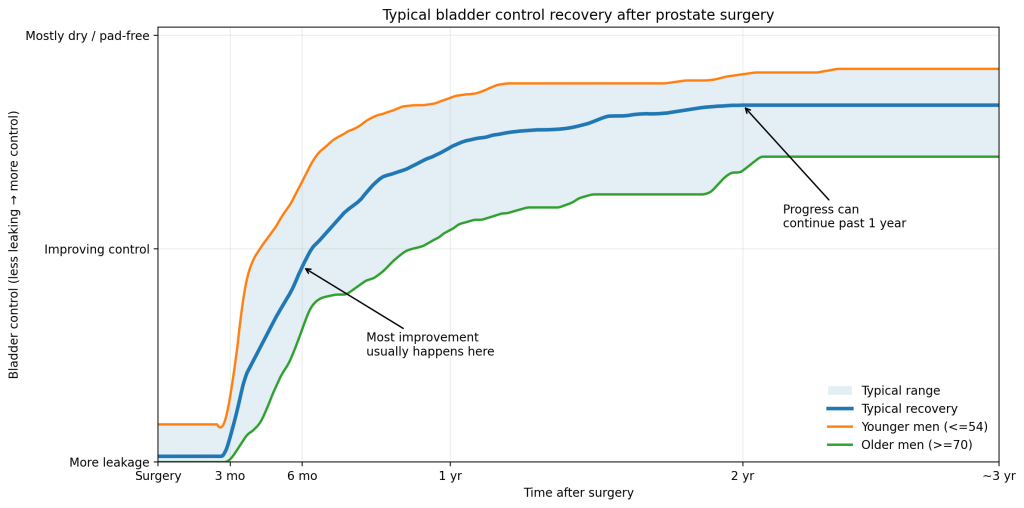
The chart below shows how bladder control typically recovers after prostate surgery and why, for many men, progress slows well before full continence is reached. If your curve has flattened, you are not outside the norm.
Identifying your pattern is the first step toward finding the right support.
Why Recovery Often Plateaus
Early improvement after prostate surgery comes from the body healing. As swelling reduces, nerves reawaken, and muscles regain basic coordination. Those early gains can feel encouraging. But for many men, progress slows or stops after the first year, and that is where the frustration sets in.
This is not failure. It is a shift from healing mode to adaptation mode, and it requires a different response.
Once the initial healing phase ends, the sphincter muscle may still work but tire quickly during movement. Scar tissue and permanent anatomical changes can also affect how well the urethra seals under pressure. These are mechanical realities, not motivational ones. No amount of patience alone will resolve them.
When Habits Become the Problem
Without realizing it, many men quietly adapt around their leakage, clenching constantly, restricting fluids, or building their entire day around bathroom access. These habits feel protective in the moment, but over time they increase fatigue, limit genuine recovery, and can lead to further complications.
Real progress often starts with unlearning these patterns.
What Actually Helps
When recovery stalls, the answer is rarely more effort — it is smarter support.
Get clarity first. Understanding what is actually limiting your progress reduces anxiety, opens new options, and prevents unnecessary procedures
Match your support to your current stage. Non-surgical options that reduce sphincter workload and improve sealing during activity can make a meaningful difference, especially before considering permanent surgical intervention
Focus on function, not force. Timed support during movement, improving endurance rather than constant tension, and reducing unnecessary physical strain all matter more than squeezing harder
You Do Not Have to Figure This Out Alone
Long-term leakage after prostate surgery affects far more men than they talk about. The silence around it does not mean solutions do not exist; it means the conversation has not been loud enough yet.
Contino® exists to change that. Whether you are one year post-surgery or ten, there are options worth exploring and a team ready to support you.
Are You Looking to Stop Bladder Leakage?
Book a free telephone consultation with one of our nurses to see if the Contino® device is a good fit for you.
Book Now